Indoor or Outdoor?
You're Asking the Wrong Question

Why testing indoors first gives you a reliable baseline, and why the next stage should deliberately put the wind back into the experiment.

wave

Indoor and outdoor pellet testing answer different questions.
One identifies the most consistent pellet; the other reveals what the wind does to it.

“Should I test my pellets indoors or outdoors?”

It sounds like a simple choice.

Indoors removes the wind, but HFT, FT, outdoor benchrest and hunting all happen outdoors. Surely a pellet should be tested in the conditions in which it will actually be used?

That argument makes sense.

But perhaps we are asking the wrong question.

Indoor and outdoor testing are not competing methods. They answer different questions.

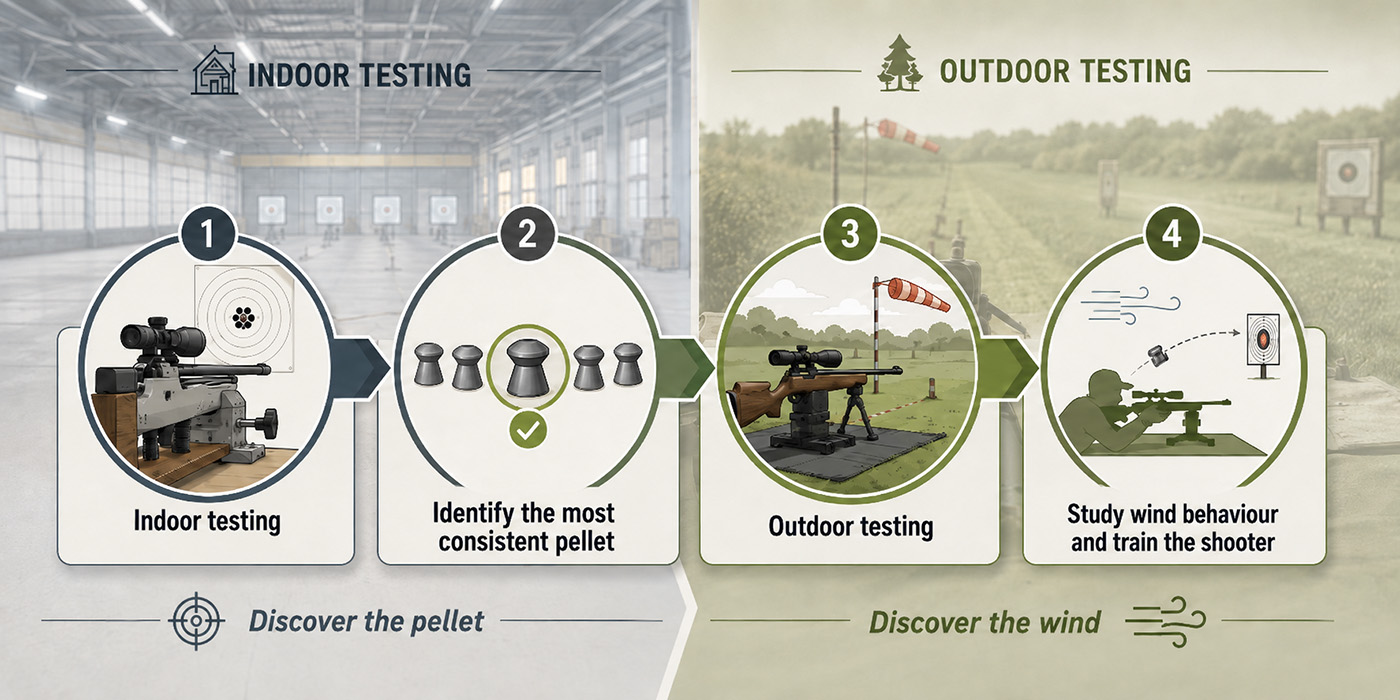
Indoor testing discovers the pellet.
Outdoor testing discovers the wind.

And they work best in that order.
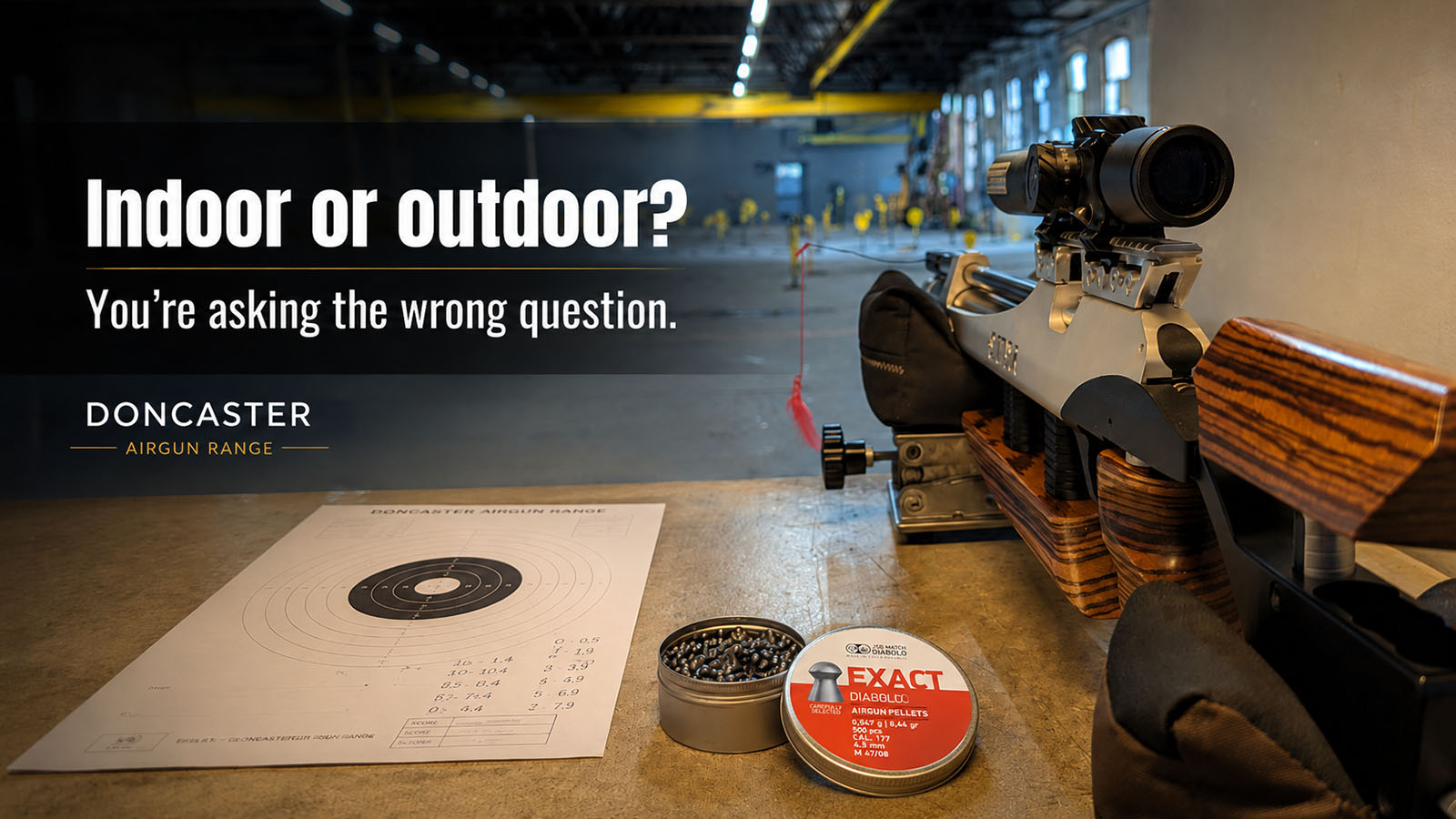
Air rifle pellet-testing setup on an indoor shooting range

What are you actually trying to find out?

Imagine that you have bought several different pellets and want to discover which one works best in your rifle.

You set up a target outdoors and shoot a group with Pellet A.

Then you shoot another group with Pellet B.

Pellet B produces the larger group.

Does that mean Pellet A is better?

Possibly.

But it could also mean the wind changed while you were shooting Pellet B.

Perhaps its speed increased. Perhaps its direction altered slightly. Perhaps the air was moving differently halfway down the range from the way it was moving beside you.

You changed the pellet, but you also allowed something else to change at the same time.

That makes the result harder to interpret.

This is the basic principle behind any useful experiment: when comparing two things, remove as many unrelated variables as reasonably possible.

If you want to compare pellets, why introduce a variable that may produce a larger effect than the difference between the pellets?
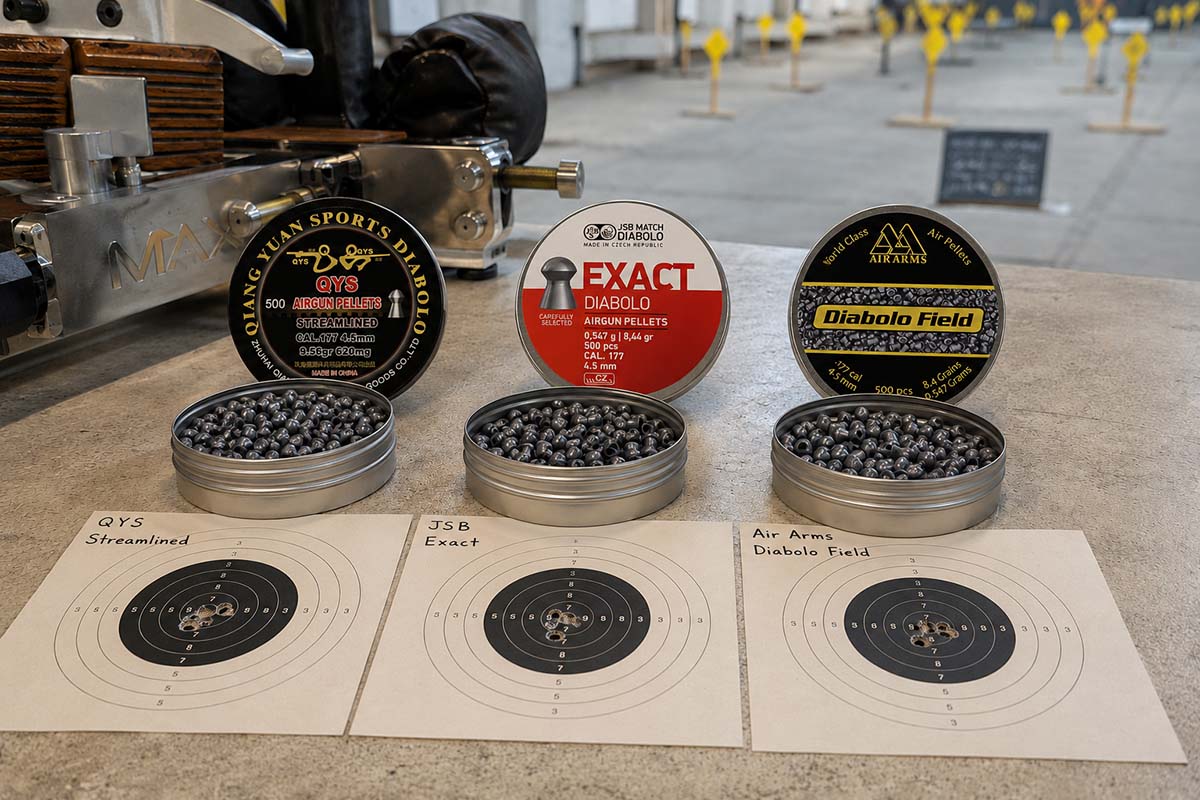
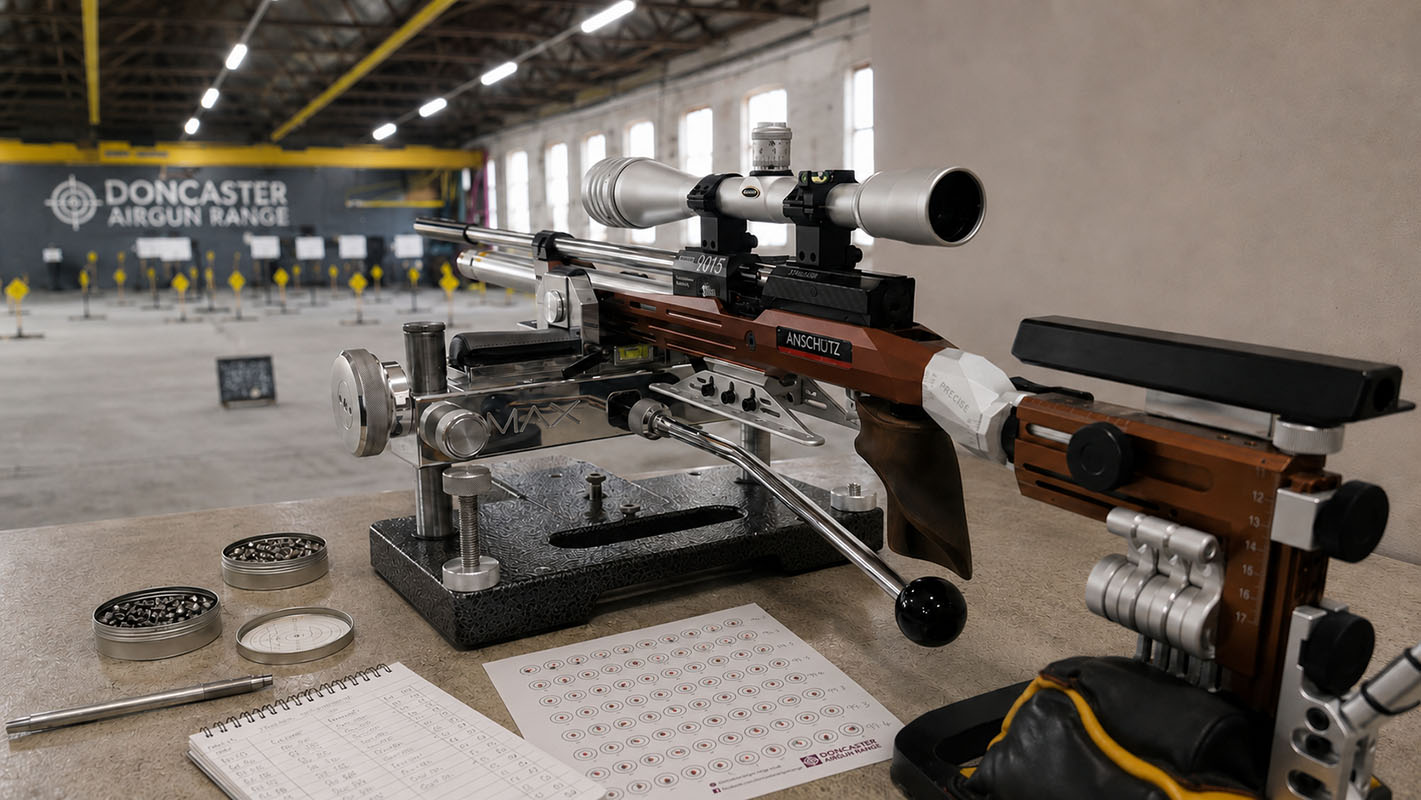
Indoors, there is nowhere for a poor pellet to hide

An indoor range does not reproduce the conditions of an HFT course, an FT course, an outdoor benchrest range or a hunting field.

That is not its purpose.

Its value is that it removes much of the atmospheric noise from the test.

You can use the same rifle, the same distance, the same shooting position and approximately the same conditions for every group. Wind is no longer scribbling its own answer across the target.

What remains is a much clearer test of the rifle and pellet combination.

Does the pellet group consistently?

Does it produce unexplained fliers?

Does one batch appear to suit the barrel better than another?

Do repeated groups support the first result, or was that beautiful group merely five fortunate shots?

Indoor testing does not tell you everything about a pellet.

It tells you something more useful at this stage: whether the pellet is worth testing further.

Different airgun pellets compared using groups shot indoors

A genuinely calm outdoor range can also provide excellent testing conditions. The important advantage is not the building itself, but the control it gives us over the conditions.

The problem is that “calm” can be deceptive.

A 2 mph wind is barely perceptible when you are sitting at an outdoor range.

Yet, even the best-performing .177 pellet will drift by around 12 mm at 35 yards in a 2 mph wind.

Wind that feels like almost nothing can move a pellet by an amount large enough to distort a meaningful comparison.

Outdoors, the difficulty is knowing whether that slight movement of air is present along the pellet's entire route, and whether it will remain unchanged throughout every comparison.

The air beside the firing point may seem still while a light current moves across the target or somewhere between the two.

An indoor range makes that uncertainty much easier to remove.

Why this matters in benchrest

This is particularly important in benchrest shooting, where very small differences in group size matter.

Indoor benchrest is sometimes dismissed as being too easy because the shooter does not have to contend with wind.

But removing the wind does not make precision irrelevant.

It makes small differences easier to see.

Indoors, a poor shot cannot be blamed on a gust that nobody noticed. The shooter, rifle and pellet combination must produce the result without the wind either damaging it or occasionally flattering it.

That controlled environment also makes results easier to compare.

Indoor conditions are broadly repeatable from one range and one day to another.

Outdoor conditions can vary between ranges, between sessions and even between consecutive shots.

That does not make indoor benchrest a replacement for outdoor benchrest.

It makes it a clearer test of precision.

This is especially valuable in postal competitions. If shooters are competing on different ranges in different parts of the country, indoor conditions create a more level playing field.

Indoors is indoors almost anywhere.

Outdoors is different everywhere, and different again a few moments later.

Indoor airgun benchrest equipment used for precision shooting

But wind matters

Of course it does.

For an outdoor shooter, choosing a pellet without ever testing it outdoors would be like choosing walking boots on a carpet and never taking them onto a hill.

Once a pellet has shown that it can perform consistently in calm conditions, the next question is how predictably it behaves in real air.

That is an outdoor question.

The important distinction is that you are no longer trying to discover whether the pellet can group.

You have already established that.

Now you are learning what the wind does to it.

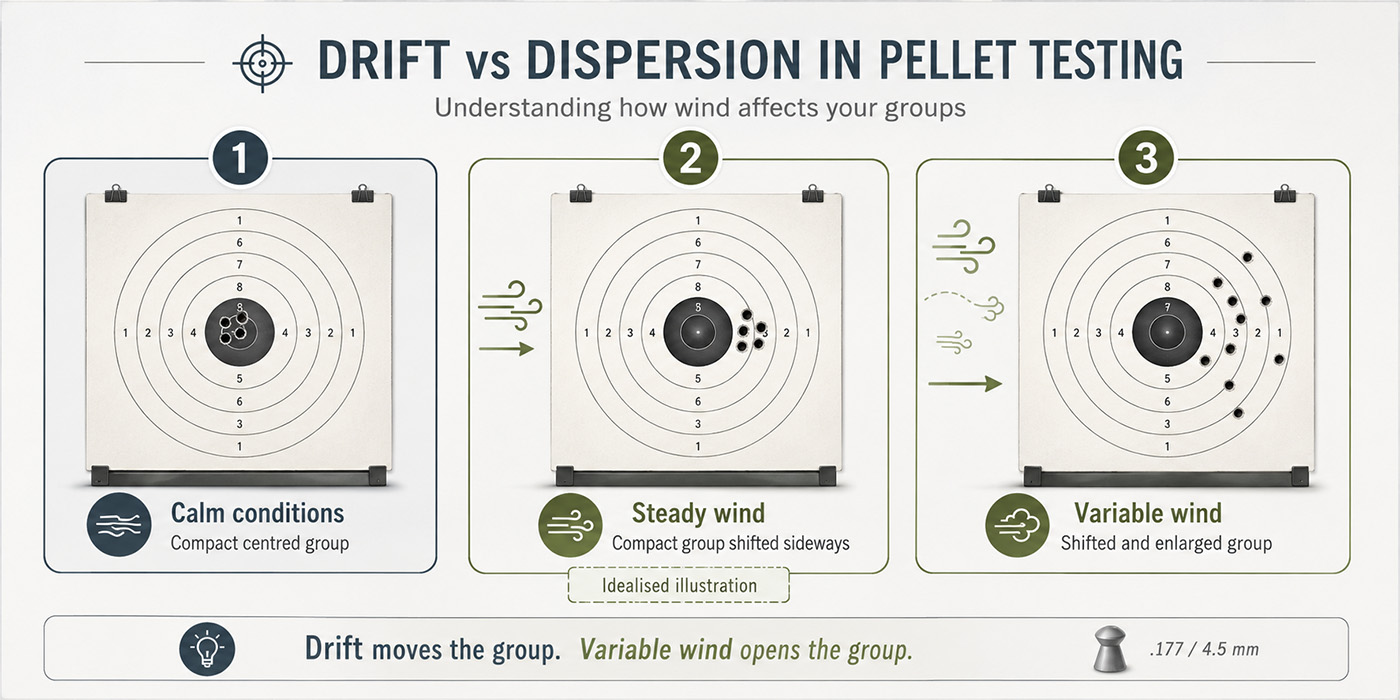
Drift and dispersion are not the same thing

Suppose Pellet A genuinely produces a 15 mm group in calm conditions.

Now imagine firing it through an ideal, perfectly uniform crosswind that remains exactly the same for every shot and along the entire route to the target.

As a useful first approximation, we would expect the group to move sideways. Its centre would land somewhere else, but much of its original shape and size should remain.

That sideways movement is average wind drift.

It is predictable enough to be allowed for. A shooter can aim into the wind or adjust the sights to compensate.

Real wind is rarely that obliging.

Its speed and direction change. It flows around trees, banks, buildings and openings. The air beside the shooter may not match the air halfway to the target.

Each pellet may therefore experience a slightly different journey.

The result is not merely a group that moves.

It may also become wider or less regular.

That is dispersion, or group growth.

Diagram showing the difference between wind drift and wind dispersion in airgun pellet groups

The distinction matters:

Drift moves the group.
Dispersion enlarges it.

Drift can be allowed for. Dispersion cannot.

Imagine two pellets.

Pellet A drifts 30 mm in a particular wind but repeatedly produces a fairly compact group.

Pellet B drifts only 25 mm on average, but its shots spread across a much wider area.

Pellet B has technically drifted less.

But Pellet A may still be the better choice.

Why?

Because a consistent amount of drift can be learned. You can build experience, recognise similar conditions and make an allowance.

An unpredictable spread cannot be dialled out or held off for. You do not know where within that larger area the next pellet will land.

Drift can be allowed for. Dispersion cannot.

This is why the pellet with the least average wind movement is not automatically the pellet that will produce the best results outdoors.

Predictability matters.

Pellets do not all behave identically in flight. Small differences in shape, drag, velocity retention and aerodynamic behaviour can affect both how far they move in the wind and how consistently they behave from shot to shot.

We do not need to untangle every aerodynamic detail before choosing a pellet.

We simply need to ask the right question at the right stage.

Why outdoor pellet comparisons are difficult

Outdoor testing can certainly reveal a poor pellet.

If one type repeatedly produces terrible groups while another remains tight, the difference may be obvious enough to overcome the uncertainty introduced by the wind.

The difficulty arises when comparing two reasonably good pellets.

Their true difference may be small.

A slight change in wind between groups can easily disguise that difference, exaggerate it or reverse it.

Even alternating between pellets does not remove the problem completely. The wind experienced by one shot is never guaranteed to be identical to that experienced by the next.

The test has begun to measure several things at once:

  • the pellet;
  • the rifle;
  • the shooter;
  • the wind;
  • and the shooter's interpretation of the wind.

Those are all worth studying.

They are simply not best studied simultaneously.

A better two-stage process

The solution is not to declare indoor testing superior to outdoor testing.

It is to stop asking one environment to do the other's job.

Some outdoor ranges try to reduce the effects of wind with fences, screens or windbreaks.

That may make shooting more comfortable, but it can also turn the range into an imperfect imitation of an indoor one.

The wind may be reduced without being removed. Air flowing around and over barriers can create quieter areas in one place and less obvious, less predictable movement in another.

That gives you neither the controlled conditions of an indoor test nor the natural wind exposure that makes outdoor testing valuable.

Some outdoor ranges try so hard to become indoor ranges that they forget their own strength.

Do not ask an outdoor range to imitate an indoor range.

Use each environment for what it does best.

Indoors, remove the wind because it contaminates the pellet test.
Outdoors, embrace the wind because it is now the subject of the test.

Two-stage airgun pellet testing process using indoor testing followed by outdoor wind testing

Stage one: test indoors

Use indoor testing to reduce the field to the pellets that perform consistently in your rifle.

Shoot more than one group with each candidate. A single small group can flatter a mediocre pellet, while one poor shot can unfairly condemn a good one.

Keep the rifle, distance, support and shooting process as consistent as possible.

For a benchrest shooter, this controlled baseline is especially valuable. It shows what the rifle, pellet and shooter can produce before variable wind is added to the problem.

At this stage you are asking:

Which pellet gives me the most repeatable precision when wind is removed from the test?

Stage two: test outdoors

Take the strongest candidates outside.

Choose targets with a reasonably exposed pellet route rather than targets deliberately sheltered from the wind.

You are not trying to recreate indoor conditions.

You want the wind.

Now observe more than where the group lands.

Look at how the group changes.

Does it remain reasonably compact?

Does it move predictably as the wind changes?

Does it produce occasional unexplained departures from the rest of the group?

Can you recognise what the pellet is doing and make useful corrections?

At this stage you are asking:

How does this known-good pellet behave in real wind, and can I learn to use that behaviour?

The shooter is part of the second experiment

Outdoor testing does more than evaluate equipment.

It trains the shooter.

Wind indicators, vegetation, mirage, exposed gaps and the feel of the air are all clues. Over time, you begin to connect those clues with what appears on the target.

That learning is difficult when you do not yet trust the pellet.

This applies just as strongly to outdoor benchrest as it does to HFT, FT or hunting.

A benchrest shooter may see a shot land outside the main group, but without a reliable indoor baseline there are several possible explanations.

Was it the wind?

Was it the pellet?

Was it the rifle?

Or was it the shot itself?

Indoor testing cannot teach the shooter to read wind.

It can remove some of those competing explanations.

Once you know what the rifle and pellet can do in controlled conditions, outdoor groups become more informative.

You can begin to separate the limitations of the equipment from the effects of the atmosphere and your own decisions.

Indoor practice does not weaken outdoor performance.

It gives the outdoor shooter a known starting point.

You cannot understand what the wind changed until you know what the rifle could do without it.

Indoor or outdoor?

Both.

But not because one confirms the other.

They perform different jobs.

An indoor range is not a replacement for outdoor shooting. It is a controlled environment for comparing equipment and measuring precision.

An outdoor range is where that equipment meets the moving atmosphere and where the shooter learns to interpret it.

So the better question is not:

“Should I test indoors or outdoors?”

It is:

“What am I trying to discover?”

Test indoors to discover the pellet.
Test outdoors to discover the wind.

Do them in that order.

Key takeaway

Indoor and outdoor pellet testing are not alternatives.

  • Indoors: find the pellet that groups consistently without wind confusing the result.
  • Outdoors: learn how that known-good pellet drifts and disperses in real conditions.
  • Do not ask one environment to do the other's job.
  • Test indoors to discover the pellet. Test outdoors to discover the wind. Do them in that order.

References and further reading

The technical claims in this article draw on the sources below.

  • The Beaufort Wind Scale Land-based Beaufort table: Force 1 "Light Air" (1-3 mph) is shown only by smoke drift, not felt on the face - supporting the "almost nothing" wind claim in this article.
  • 2 mph wind drift worked example JSB Exact .177, 8.44 gr, 800 ft/s, 11.99 ft-lb, GA BC 0.0221, 2 mph wind at 90 degrees, producing 12 mm calculated drift at 35 yards. Calculated in-house rather than drawn from an external source, to support the worked example used in this article. This is one of the better-performing .177 pellets, run near the top of the UK legal power limit - a lower-BC pellet would drift more than 12 mm in the same wind, not less.
  • Influence of air rifle pellet geometry on aerodynamic drag Peer-reviewed experimental research showing that differences in air-rifle pellet geometry affect aerodynamic drag. ResearchGate hosts a copy of the paper; the journal of record is cited above.
  • The External Ballistics of Diabolo Pellets Explains diabolo pellet external ballistics and how ballistic coefficient affects wind drift.
  • Wind Drift for Airguns: It's Important Where the Wind Is! Explains why wind acting at different points along a pellet's flight path produces different amounts of deflection. Does not itself establish this article's drift-versus-dispersion distinction.