Why Airgun Pellets Hit Higher When Shooting Uphill or Downhill

The physics behind angled airgun trajectories: why uphill and downhill shots land higher, and why they behave almost the same either way.

wave

Angled shots confuse shooters: a pellet strikes higher than expected whether the target is above or below. Surely gravity should hinder it uphill and help it downhill? The answer is clearer once you look at gravity's direction, not its strength.

A common explanation of angled shooting goes something like this:

When you shoot uphill, the pellet has to fight gravity.

That is usually followed by the apparent opposite:

When you shoot downhill, gravity is helping the pellet.

Both statements contain a tiny grain of truth.

Neither explains where the pellet lands.

The important thing is not whether the pellet is travelling upwards or downwards. It is the direction of the pellet’s path compared with the direction of gravity.

The rifle rotates. Gravity doesn't.

Gravity continues to pull vertically towards the Earth. When the rifle is tilted, the direction of the pellet changes, but gravity carries on pulling in exactly the same direction as before.

That changes how gravity affects the pellet’s path.

It is why an angled pellet normally lands higher than expected whether the target is uphill or downhill.
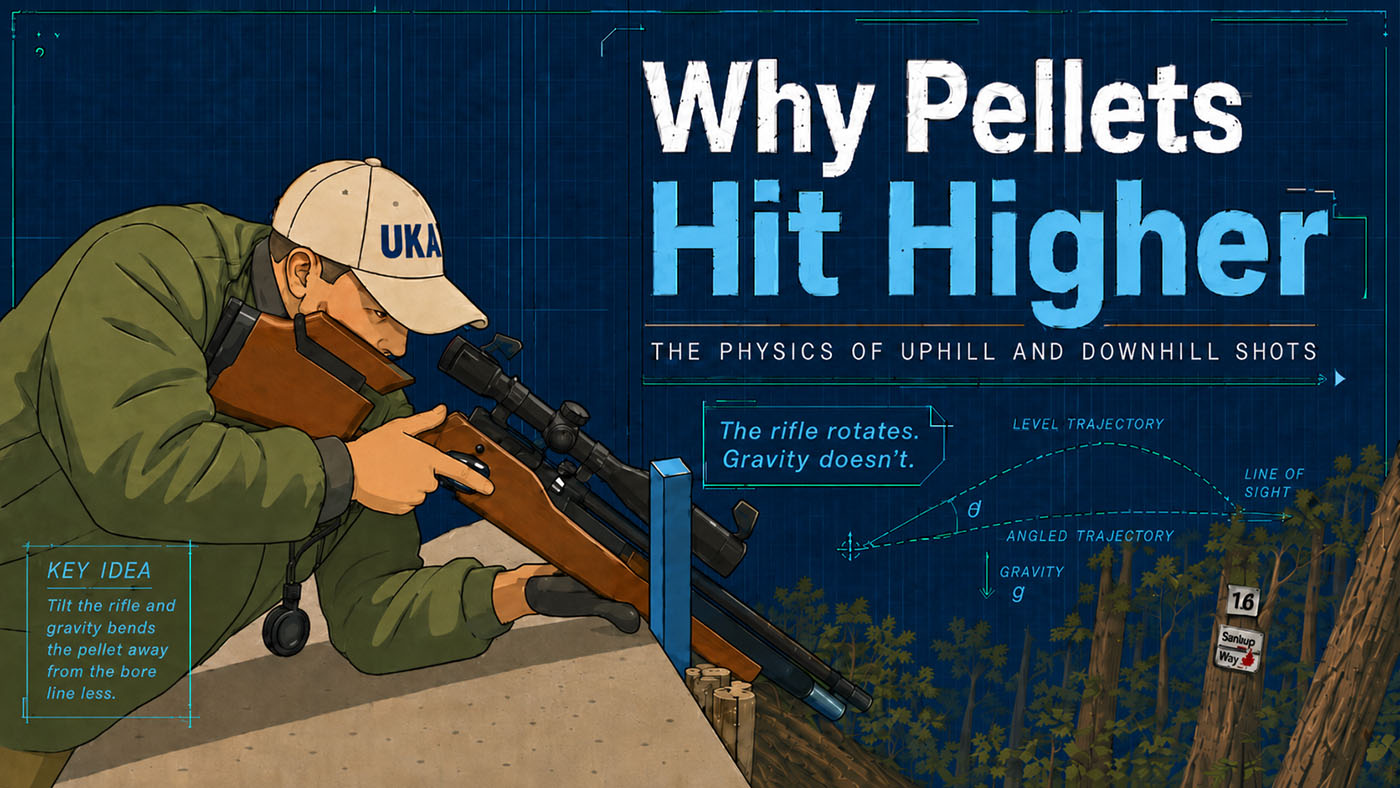
Air rifles aimed uphill and downhill with gravity acting vertically and both pellet paths curving less than a level shot

Start with a level shot

When an air rifle is fired level, the pellet initially travels forwards while gravity pulls vertically downwards.

Gravity is therefore acting almost completely across the pellet’s path.

As the pellet travels, gravity continually pulls it away from the bore line. This produces the familiar curved trajectory shown by ballistic calculators.

Air resistance makes the real flight of an airgun pellet more complicated than a simple schoolbook parabola. The pellet loses velocity throughout its flight, so the curve becomes progressively steeper.

But the basic principle is simple:

On a level shot, gravity bends the pellet away from the bore line as strongly as possible.

Now point the rifle vertically

Imagine pointing the rifle directly upwards.

Gravity is still pulling vertically downwards, but the pellet is now travelling along the same line.

Gravity slows the pellet, but it does not pull it sideways away from the bore line.

Now point the rifle directly downwards.

Gravity gives the pellet a tiny bit of help with its forward speed, but again it acts along the direction of travel rather than pulling the pellet away from the bore line.

In still air, both pellet paths remain straight relative to the bore:

  • straight upwards;
  • straight downwards.

Their speeds change, but gravity does not create the familiar curve away from the bore line.

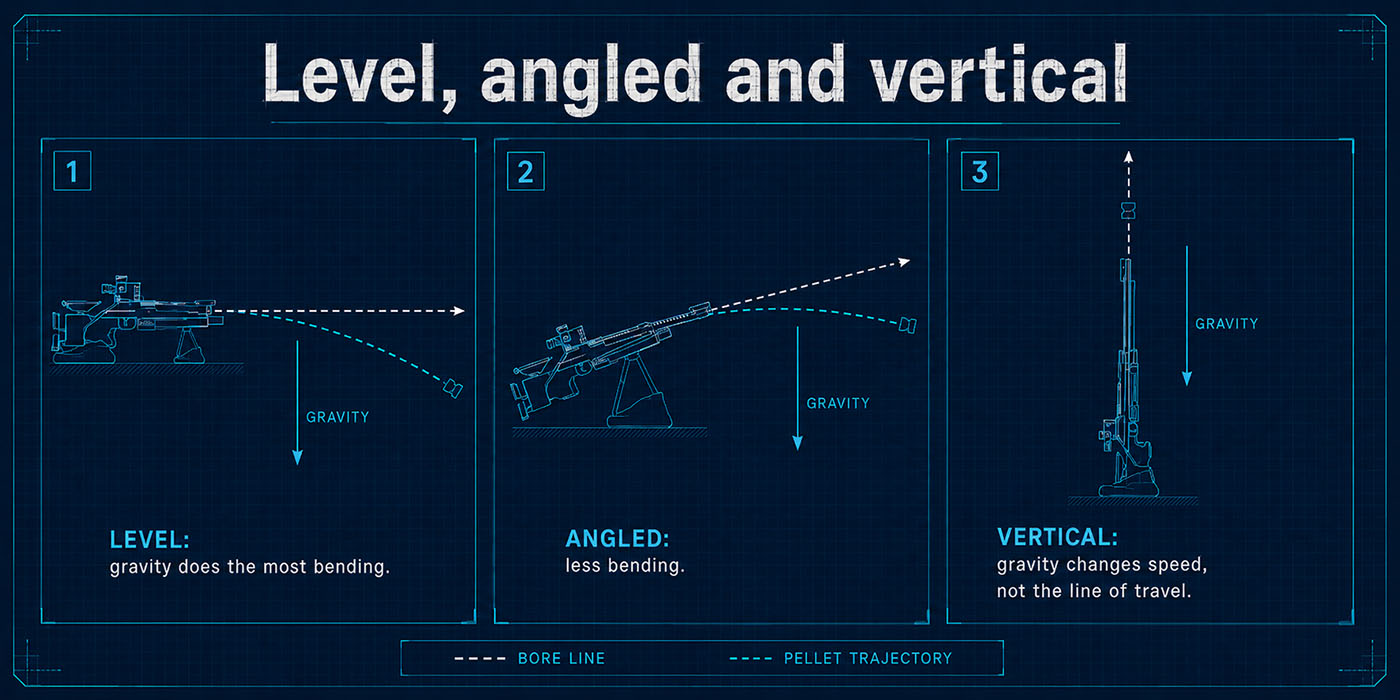
Every other firing angle lies somewhere between those two extremes:

  • level, where gravity does the most bending;
  • vertical, where gravity changes speed but does no bending away from the bore line.
Comparison of level, angled and vertical airgun shots showing progressively less curvature away from the bore line

Gravity has not become weaker

It is tempting to say that gravity has “less effect” on an angled shot.

That is not quite right.

Gravity remains exactly the same. What changes is the direction of the shot.

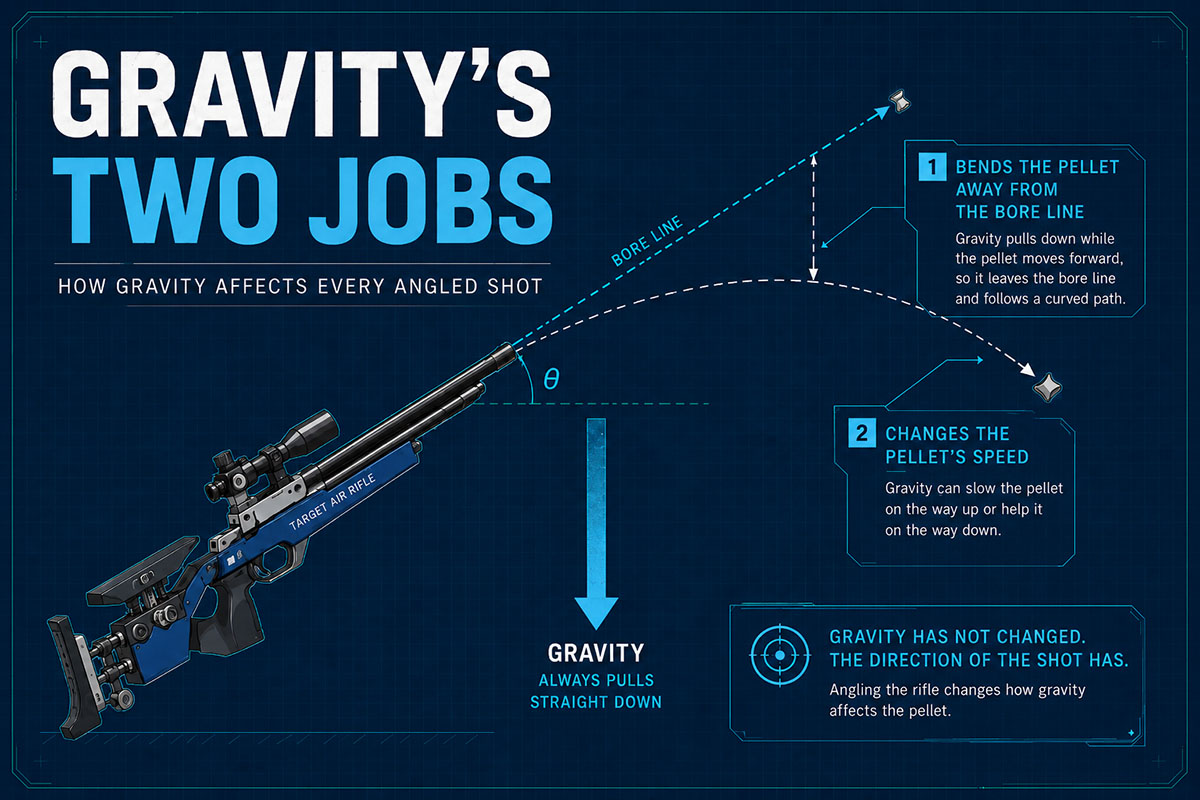
Gravity is doing two jobs:

  1. bending the pellet away from the bore line;
  2. changing how fast the pellet is travelling.

When the rifle is level, almost all of gravity’s effect bends the pellet away from the bore line.

As the rifle points more steeply up or down, gravity does less bending and more speeding up or slowing down.

Angle does not weaken gravity. It changes which job gravity is doing.

Gravity shown bending the path and changing the speed of an angled airgun pellet

This change is not directly proportional to the firing angle.

A 45-degree shot is not exactly halfway between level and vertical. At 45 degrees, rather more than two-thirds of gravity’s trajectory-bending effect is still present.

That effect is reduced to half at about 60 degrees.

You do not need to remember the maths behind it. The useful bit is:

Small angles make only a small difference. The effect grows much more quickly when the shot becomes steep.

Why uphill and downhill behave the same

This is the part many shooters struggle to accept.

Surely gravity must make an uphill pellet land lower because the pellet has to climb?

And surely gravity must make a downhill pellet land higher because gravity is helping it?

The problem with that explanation is that it concentrates on the pellet’s forward speed rather than the much more important bending of its path.

When the rifle is tilted uphill, gravity bends the pellet away from the bore line less than it does on a level shot.

When the rifle is tilted downhill by the same amount, gravity also bends the pellet away from the bore line less.

That is the main thing going on, and it is the same in either direction.

In both cases:

  • the pellet bends less away from the bore line;
  • the pellet path sits above the equivalent level-shot path;
  • the shooter normally needs less holdover than for the same distance on level ground.

Uphill and downhill are not opposites. They are the same angle pointing in different directions.

But doesn’t gravity slow the pellet uphill and speed it up downhill?

Yes, but only by a tiny amount.

Gravity acts partly against the pellet’s motion uphill and partly with it downhill.

But an airgun pellet starts its flight at well over 500 miles per hour and normally reaches the target in a small fraction of a second. Gravity has hardly any time to change its forward speed.

A detailed point-mass calculation can detect a difference between equal uphill and downhill shots, but at normal airgun distances we are talking about fractions or even thousandths of a millimetre.

That difference is physically real.

It is not something a shooter can see, aim for or make useful.

It certainly does not rescue the idea that uphill and downhill need opposite corrections.

For practical airgun shooting:

Equal uphill and downhill angles can be treated as requiring the same correction.

How different are uphill and downhill, really?

A detailed calculation can detect a tiny difference because gravity slightly slows the pellet uphill and slightly helps it downhill. At ordinary airgun distances, the resulting difference is measured in fractions or thousandths of a millimetre rather than anything a shooter could deliberately aim for. For practical purposes, equal uphill and downhill angles require the same correction.

Why the pellet lands higher than expected

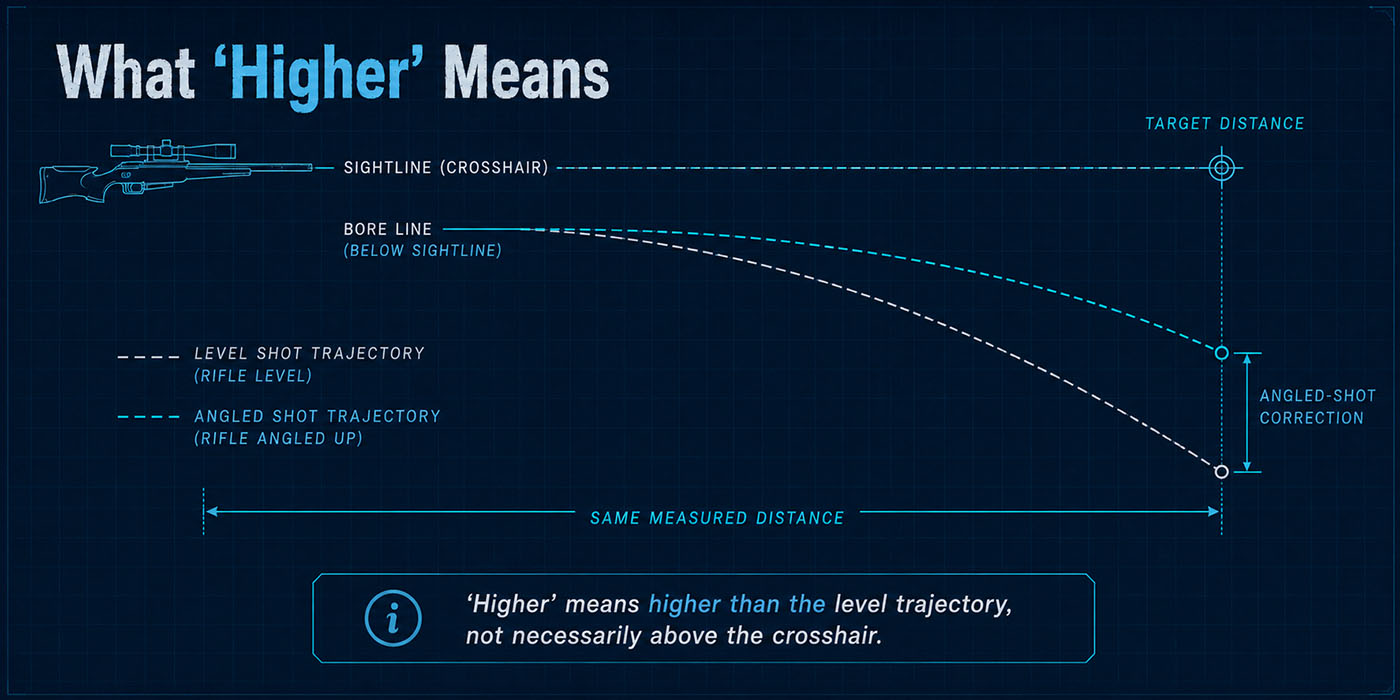
An angled shot does not necessarily land above the crosshair.

When shooters say that an angled shot “lands higher”, they mean:

The angled pellet path is higher than the level pellet path would have been at the same measured distance.

Both paths may still be below the sightline.

For example, a close target may normally require considerable holdover because the scope sits above the bore.

The angled shot may still require holdover, but it will usually require less than the same target would on level ground.

So the useful comparison is not:

  • pellet versus target centre;
  • pellet versus crosshair;
  • uphill versus downhill.

It is:

  • angled pellet path versus level pellet path at the same distance.
Level and angled pellet trajectories showing the angled path higher than the level path while both remain below the sightline

Trajectory and sightline are different things

The pellet’s trajectory is the physical path taken by the pellet.

The sightline is the straight line running through the scope towards the aiming point.

Scope height and zero distance determine how that sightline sits in relation to the pellet’s trajectory.

They do not create or change the physical trajectory itself.

This matters because there are two different questions a shooter might ask.

How much does the angle change the pellet’s path?

This compares:

  • the pellet fired level;
  • the same pellet fired at an angle.

Scope height and zero distance are not needed because the comparison is between two physical pellet paths.

Compare pellet with pellet, and the scope disappears.

Where should I aim with my rifle?

That compares the pellet’s path with the sightline.

Scope height and zero distance are then essential because they determine where the crosshair sits in relation to the trajectory.

The angled-shot correction and the complete aim point are related, but they are not the same calculation.

An extreme real-world example

The rifle setup in this example is fairly typical for HFT:

  • .177 JSB Exact-class pellet;
  • muzzle velocity of 777 fps;
  • ballistic coefficient of 0.021 using the GA drag model;
  • line-of-sight height of 45 mm;
  • zeroed at 30 yards;
  • fixed UK reference atmospheric conditions.

The target is anything but typical.

I have shot an 8-yard target at about 80 degrees before, almost directly above the firing point, but I have only seen a target like that three times in more than 25 years of competition shooting.

It is an extreme example and probably not one that would be considered acceptable now.

That makes it useful here, though, because extreme cases are good at exposing where a rough rule falls apart.

Normal level-shot aim

At 8 yards on level ground, this setup requires about:

2½ Mildots (MRAD) of holdover.

Most of that close-range holdover exists because the scope is mounted above the bore and the pellet has not yet risen far enough to meet the sightline.

Ballistically calculated angled aim

A point-mass trajectory calculation shows that the steeply angled shot requires about:

2 Mildots of holdover.

The angle has reduced the required holdover by roughly half a Mildot.

At 8 yards, that moves the pellet by less than one pellet width.

That is a useful correction, but it is still clearly an 8-yard aim point.

The target has not somehow moved to almost touching the muzzle.

Where the Rifleman’s Rule goes wrong

The traditional Rifleman’s Rule says that an angled target can be treated roughly as though it were at its horizontal distance rather than its full distance through space.

For an 8-yard target at about 80 degrees, that horizontal distance is only around:

a yard and a half.

If that figure is used as though it were an ordinary level-shot distance on the trajectory chart for this scoped air rifle, the suggested aim becomes something like:

30 Mildots of holdover.

You’d need to borrow some Mildots from your mates if you wanted to make that shot!

The target is still 8 yards away through space. It does not become a yard and a half from the scope just because it is overhead.

The horizontal distance tells us something useful about how much gravity bends the pellet’s path.

It does not replace the whole shot with an ordinary yard-and-a-half sight picture.

For airguns, particularly below about 25 yards, scope-to-bore geometry is a big part of the complete aim point.

Using the Rifleman’s Rule as a replacement range can therefore be not only wrong, but spectacularly wrong.

That is especially true when the shot is:

  • close;
  • steep;
  • taken with a scope mounted well above the bore.

The Rifleman’s Rule is a rough shortcut. It is not a reliable replacement for a proper ballistic calculation of close, steep airgun shots.

A target 8 yards away does not become a yard and a half from the scope just because it is overhead.

Why a point-mass calculation gives a better answer

A simple geometric rule assumes that the angled shot can be represented by a different level distance.

A point-mass ballistic calculation does not need to make that substitution.

It calculates the pellet’s flight directly.

The calculation accounts for:

  • muzzle velocity;
  • ballistic coefficient;
  • changing velocity;
  • aerodynamic drag;
  • gravity;
  • firing angle;
  • atmospheric conditions;
  • time of flight.

It can therefore calculate:

  1. the pellet path when the rifle is level;
  2. the pellet path when the rifle is angled;
  3. the difference between those two paths.

That gives a ballistically calculated correction rather than a guessed equivalent range.

What makes the correction larger?

The correction normally grows when the shot becomes steeper or the pellet remains in flight longer.

Angle

Small angles leave most of gravity’s trajectory-bending effect unchanged.

As the shot becomes steeper, gravity does less bending and the difference from the level trajectory becomes larger.

Distance

A longer journey gives the difference more time to build up.

A very steep shot at short range may still need only a modest correction because the pellet reaches the target quickly.

Muzzle velocity

A faster pellet normally reaches the target sooner, leaving less time for the difference between the level and angled paths to develop.

Ballistic coefficient

A pellet that retains velocity well generally spends less time in flight than one that loses velocity quickly.

That is why an accurate calculation needs a realistic muzzle velocity and ballistic coefficient.

What the physics can and cannot tell us

The physics can calculate the difference between the level and angled pellet paths.

It can tell us whether the difference is:

  • a fraction of a millimetre;
  • several millimetres;
  • a significant part of the target.

It cannot decide how accurately the shooter knows:

  • the distance;
  • the angle;
  • the pellet’s ballistic coefficient;
  • the rifle’s actual muzzle velocity.

Nor can it decide how precisely the shooter can apply the correction from the available position.

Those are practical shooting questions rather than questions about the underlying physics.

This Reference explains why the trajectory changes.

The Angled Shot Compensation Chart calculates how much it changes.

A separate Feature article will deal with how that information can be used sensibly on an HFT course.

The two ideas worth remembering

If you remember only one sentence from this Reference, make it:

The rifle rotates. Gravity doesn't.

If you remember a second, make it:

Uphill and downhill are not opposites. In both directions, gravity bends the pellet away from the bore line less than it does on a level shot.

Gravity does slightly hinder the pellet’s forward speed uphill and slightly help it downhill.

But the pellet is travelling at several hundred miles per hour and is in flight for only a fraction of a second.

That tiny speed difference is not why angled shots land higher than expected.

The main effect is the reduced bending away from the bore line, and that happens whether the target is above or below the shooter.

Summary

Gravity always pulls vertically towards the Earth.

When the rifle is level, gravity bends the pellet away from the bore line as strongly as possible.

As the rifle is tilted uphill or downhill:

  • gravity does less bending;
  • gravity does slightly more speeding up or slowing down;
  • the pellet curves away from the bore line less;
  • the angled trajectory sits above the corresponding level-shot trajectory.

The effect is practically the same uphill and downhill.

The difference in forward speed caused by gravity is measurable in a detailed calculation, but at normal airgun distances its effect on the result is tiny.

For close and steep airgun shots, replacing the real distance with horizontal distance can produce wildly misleading scoped aim points.

A point-mass ballistic calculation gives a better answer because it calculates the actual level and angled pellet paths rather than substituting a guessed equivalent range.

The difference between uphill and downhill is real. It is also far too small to be useful.

Related content